

Understanding the stock market is the first step toward smart investing and safeguarding your wealth. While the stock market offers significant wealth-building opportunities, it can be complex and volatile. This is especially true for beginners. By brushing up on stock market basics and learning key strategies for portfolio protection, you can invest with confidence while protecting your investment portfolio from unnecessary risks.
Stock Market Basics Explained for Beginners
Stock market basics start with understanding what stocks are and how the market works. A stock represents a unit of ownership in a company, so when you buy a company’s stock, you become a shareholder owning a fraction of that business. Companies initially sell stock to the public through an Initial Public Offering on the primary market, after which those shares trade on the secondary market where investors buy and sell among each other.
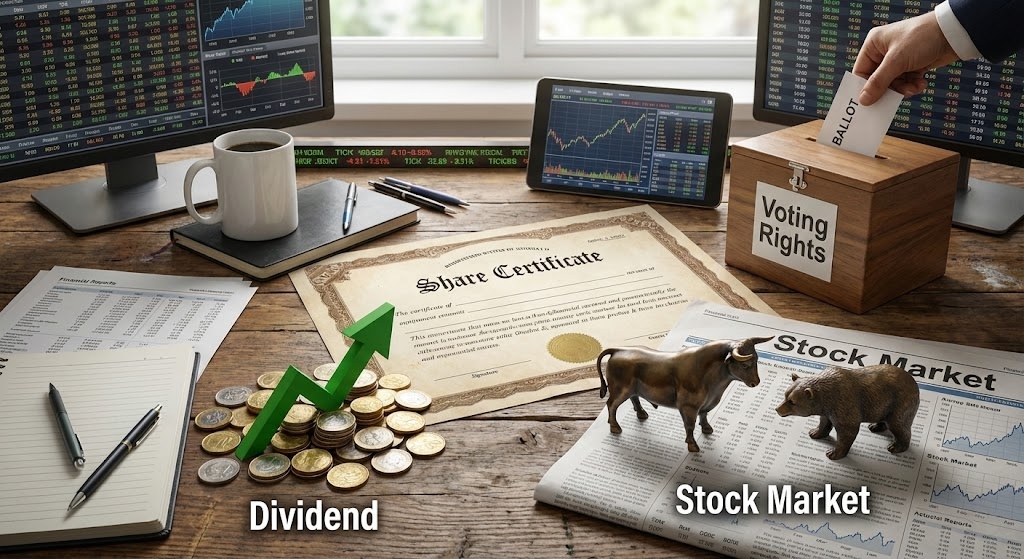
Why People Invest in Stocks
The primary appeal is the potential for higher returns compared to many other assets. Investors make money in two main ways: they can buy low and sell high for capital gains, or they can receive dividends, which are profit distributions from companies.
Understanding the Risks
Stock investing for beginners is not a surefire path to riches. It comes with significant risks. Stock prices fluctuate constantly due to supply and demand and various factors. A company’s financial health, economic conditions, interest rates, politics, and market sentiment all influence prices.
Owning stocks means you could lose money, as share prices can fall sharply, even to zero in the worst-case scenario if a company goes bankrupt. Stockholders are last in line to be paid in a bankruptcy and could potentially lose their entire investment, while dividends are never guaranteed as companies can reduce or cancel them during hard times. Being aware of these risks is essential as you start investing.
How to Invest in Stocks Safely

For beginners wondering how to invest in stocks safely, the journey should start with education and careful planning.
Set Clear Goals and Understand Your Risk Tolerance
Determine why you are investing and what your time horizon is. Are you investing for long-term growth such as retirement in 20 years, or are you seeking short-term gains? Your goals will inform your strategy. Equally important is assessing your risk tolerance. How much volatility can you stomach?
If you have a low-risk tolerance or a short time horizon, you may want a more conservative portfolio with fewer stocks and more stable assets. If you are young with decades ahead, you can afford to ride out downturns and may allocate more to stocks. Being realistic about your comfort with risk will help you craft an investment approach you can stick with even when the market gets choppy.
As you approach retirement, it often makes sense to shift into more stable investments like bonds or cash to protect against a sudden market drop. Younger investors far from retirement should not be too frightened by short-term volatility, as they have time to recover and stocks have historically delivered strong long-term gains.
Learn the Basics and Choose an Investment Account
If you are new, take time to learn investing terminology and concepts. Understand types of stocks such as common versus preferred shares, learn about categories like blue-chip, growth, and value stocks, and understand how orders work. You will need a brokerage account to actually buy stocks. Many beginners start with an online brokerage platform or a robo-advisor.
Ensure any broker or advisor you use is licensed and reputable. In the U.S., brokers must be registered with the SEC or FINRA. Choosing a trusted brokerage gives you access to the stock market and often educational resources, with some platforms even offering paper-trading accounts where you can practice with virtual money first.
Diversify Your Investments
A golden rule for investing in stocks for beginners is not to put all your eggs in one basket. Diversification means spreading your money across different investments so that no single poor performer can tank your entire portfolio. At the basic level, this means buying shares of different companies across various industries, such as technology, healthcare, finance, and other sectors rather than concentrating on one stock.
Even better, consider diversified funds like index funds or ETFs that automatically hold dozens or hundreds of stocks. An S&P 500 index fund gives you tiny ownership of 500 companies, providing broad exposure in one purchase. Diversification can also mean including other asset classes like bonds or real estate alongside stocks.
A well-diversified portfolio can improve your risk-adjusted returns. Losses in one area may be offset by gains in another, making this an effective investment-risk-management strategy used by professionals worldwide.
Do Your Research
Before buying any stock, research the company by examining its earnings, growth prospects, and industry position—the fundamentals—as stocks of companies with strong fundamentals (healthy profits, growing revenue, and manageable debt) are more likely to deliver steady returns. You can find information in annual reports, SEC filings, and analyst reports.
Start Small and Think Long Term
When you are ready to invest, you do not need a fortune, as even a small amount is enough to begin, and it is wise for beginners to start with a modest investment while learning how the stock market works. You can add more over time as you gain confidence.
Invest with a long-term mindset, as while the stock market will have ups and downs, historically the long-term trend has been upward for well-chosen investments. Time in the market beats timing the market. Trying to perfectly time when to buy or sell is extremely difficult even for experts, so staying invested through market cycles usually yields better results.
Keep Costs Low
As a new investor, pay attention to investment fees and costs. High fees can eat into your returns over time. Many online brokers today offer zero-commission stock trades, though if you invest in mutual funds or use certain advisors, there may be expense ratios or management fees. Opt for low-cost index funds or ETFs when possible, as they often have tiny fees compared to actively managed funds, and over decades, saving a percent or two in fees can make a big difference in your portfolio’s value.
Smart Investing Strategies and Understanding Market Trends
Successful smart investing is as much about strategy and discipline as it is about picking the right stock.
Stay Informed and Use Market Analysis
The stock market is dynamic, making it important to stay informed about economic and market trends, as investors use two main approaches to analyze stocks. Fundamental analysis evaluates a company’s financials and business prospects, while technical analysis studies charts and price patterns, though as a beginner, you should focus on fundamentals. Understand what drives a company’s profits and growth.
Keep an eye on big-picture trends as well, as interest rate changes, inflation, and global economic indicators can signal how the market might move. Rising interest rates often cool off stock markets as borrowing costs increase for companies, while strong economic growth can boost corporate earnings and stock prices. Always maintain a healthy skepticism.
Avoid Timing the Market
While it is tempting to think you can buy before the market surges and sell before it drops, timing the market consistently is extremely difficult, and even professional investors often get it wrong.
Rather than jumping in and out based on short-term predictions, focus on time in the market. A consistent, patient investment strategy usually outperforms sporadic trading, as historical data demonstrates that staying invested through ups and downs tends to yield better results, so once you have built a portfolio that matches your goals, remain focused on your long-term plan and do not let daily headlines derail you.
During a sudden market dip, instead of panicking, remember your strategy, as if you have a long horizon, the downturn could be an opportunity to buy at lower prices. The old adage buy low, sell high applies here.
Diversification and Asset Allocation

Asset allocation is how you divide your money among different asset categories. These typically include stocks, bonds, and cash. Real estate and commodities are also options. A well thought out asset allocation aligns with your risk tolerance and goals. A moderate investor’s allocation might be 60% stocks, 30% bonds, and 10% cash. The idea is to balance risk and reward, with stocks providing growth while bonds and cash provide stability.
Over time, you should rebalance your portfolio to maintain your target allocation, as if stocks perform very well for a period, you might suddenly have 75% in stocks, which is higher risk than you intended. Rebalancing would mean selling some stocks or buying other assets to get back to your target, a discipline that forces you to trim positions that have grown and add to those that have lagged. It systematically enforces a “buy low, sell high” approach.
Diversification and proper asset allocation reduce risk and, as studies have shown, are key to portfolio diversification benefits that can improve risk-adjusted returns over the long run.
Mind Market Trends but Avoid Hype
It is useful to be aware of stock market trends, recognizing whether you are in a bull market with rising prices or a bear market with falling prices, and noting which sectors are currently driving the market. Market trends can be driven by real economic shifts like a tech boom or by investor sentiment.
Be cautious about chasing trends or the latest hot stock blindly, as by the time a trend becomes obvious, much of the easy money might have been made, and jumping in late could burn you. Investment strategies should be based on sound reasoning, not just what is popular, with a classic example being the dot-com bubble of the late 1990s. Tech stocks were soaring, and many people bought in out of fear of missing out, only to suffer when the bubble burst.
Portfolio Protection Strategies and Investment Risk Management
Even the smartest investment picks can disappoint if you do not manage risks, as protecting your investment portfolio is about preparing for market turbulence before it hits.
Assess and Align with Your Risk Tolerance
Gradually moving from stocks into bonds or cash as the target date nears is a common approach. Holding a cushion of safer assets can prevent you from having to sell stocks at a bad time, with keeping 1–2 years of living expenses in cash or short-term bonds in retirement allowing you to weather a stock downturn. You avoid liquidating investments at fire-sale prices.
If you find yourself panic-selling during every market dip, you might have too much in stocks relative to your true risk tolerance and should adjust your allocation so you can sleep at night, as a slightly lower return is worth it if it keeps you invested and avoids emotional decisions.
Diversification Across Asset Classes
Think bigger than diversification within a stock portfolio and diversify across asset classes. Different asset classes like stocks, bonds, real estate, and commodities such as gold often react differently to economic events, which is the cornerstone of hedging strategies for portfolio protection.
The Role of Gold in Portfolio Protection
No asset provides complete protection, and gold can be volatile too, not always rising in every stock bear market. Over the long run, gold’s volatility has been lower than equities and many commodities, providing balance due to its different drivers. Gold is influenced by interest rates, inflation, and geopolitical risk more than by corporate earnings.
Regular Portfolio Review and Rebalancing
Monitoring your portfolio and making adjustments is a crucial risk-management practice, as over time, different assets growing at different rates can cause your portfolio to become unbalanced. The general recommendation is to review your portfolio at least annually, though some investors do it semiannually or when allocations deviate by a certain percentage.
When you rebalance, you may sell some of what has gone up, trimming winning positions that now occupy too large a slice, and buy what has gone down or lagged. This enforced discipline helps you buy low and sell high systematically while keeping your risk level on target. Selling some stocks after a huge rally to replenish bonds and cash prevents your portfolio from becoming inadvertently too risky.
Rebalancing can feel counterintuitive, as selling winners and buying underperformers seems strange, though it is a proven method to control risk.
Avoid Overconcentration and Leverage Risks
A common mistake that increases risk is overconcentration, meaning too much of your portfolio in one investment. Sometimes a single stock can grow to become a huge portion of your holdings, and while it is great if that stock has done well, it is risky to have 40–50% of your entire portfolio in one company or sector. Consider trimming or diversifying in that case.
Be cautious with leverage or borrowed money, as margin trading can amplify both gains and losses. It is easy for a newbie to get in over their head with margin or derivatives, which can lead to losing more than the initial investment. Unless you fully understand and can manage those risks, it is safer to avoid or limit leverage, as the goal of portfolio protection is to ensure no single decision or unforeseen event can wipe you out financially.
GoldFlex: Combining Gold’s Stability with Smart Investing Returns

It is worth exploring alternative investment strategies that offer both stability and returns. The GoldFlex account is designed to leverage the safety of gold while providing more predictable returns for investors.
How GoldFlex Works
GoldFlex is not a traditional gold holding account. It is a unique system where your capital is directly invested in physical gold and then actively traded multiple times in the market to generate profit. Your money immediately goes to work through continuous gold buy and sell cycles. This aims to deliver steady yields. This approach sets GoldFlex apart from keeping gold in a vault or a standard gold savings account where the metal just sits idle with minimal interest.
Gold by itself is a non yielding asset. If you hold gold bars or a basic gold account, you do not earn interest or dividends on it. The only way you profit is if gold’s price rises. This can be a slow process and not guaranteed in the short term. Traditional gold deposit accounts offered by banks might pay a tiny interest. These rates are often very low since the bank is basically just storing the gold.
The GoldFlex Advantage
GoldFlex was created as a solution to this issue. By actively trading gold on the market, it seeks to capture gains from price fluctuations. Gold prices do move day to day. GoldFlex’s professional management takes advantage of those movements. It aims to buy low and sell high in repeated cycles, with any gains generated credited back to your account. A GoldFlex account can potentially yield more predictable and higher returns than simply holding gold passively.
Portfolio Protection with GoldFlex
This can make your overall investment portfolio more balanced and predictable. If stock markets are turbulent or bank interest rates are unattractively low, your GoldFlex investment could be steadily accumulating gains. It offers a kind of portfolio protection in that it is an independent engine of return. It does not rely on stock bulls or bond interest rates.
Conclusion
This guide covered the essentials of understanding the stock market, exploring the basic mechanics of how stocks and exchanges work and discussing strategies for smart investing and methods of portfolio protection.
For beginners, the crucial takeaways are to educate yourself, start with a plan aligned to your goals, always diversify, and manage risks. The stock market can be a powerful engine for wealth creation.
By staying focused on the long term and keeping your emotions in check, you can navigate through the market’s ups and downs. Use tools like asset allocation, diversification, and innovative accounts like GoldFlex to stabilize returns.
Successful investing is about making informed decisions and leveraging the right strategies to meet your objectives. Whether you aim to grow your wealth aggressively or preserve what you have with steady, predictable gains, there are strategies and products to suit your needs.