
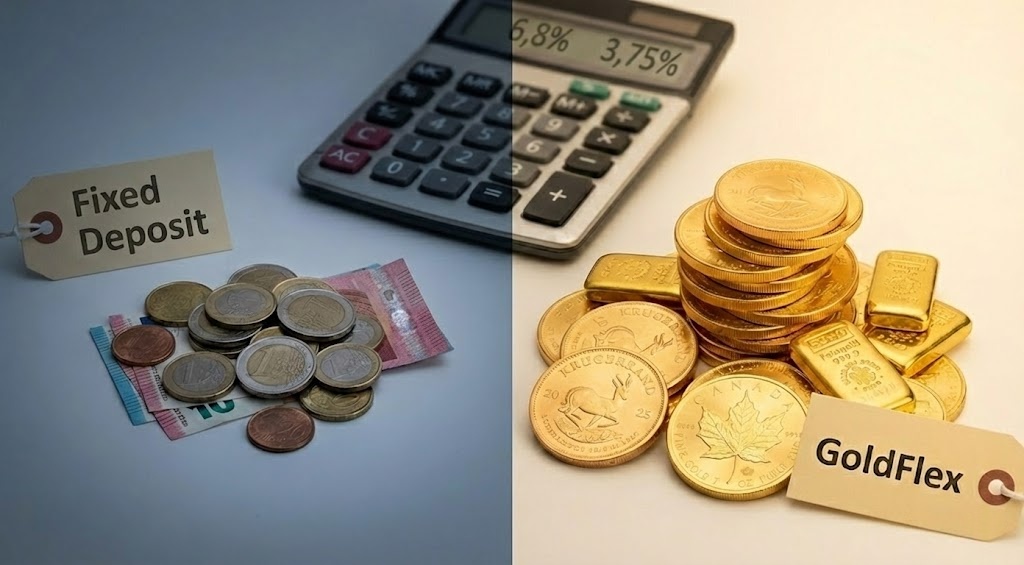
Investors worldwide are searching for certificate of deposit alternatives that offer higher returns without sacrificing safety. Traditional certificates of deposit (CDs) provide steady, guaranteed interest, but their fixed rates often struggle to keep up with inflation. This has prompted savers to explore innovative options like GoldFlex, a program that uses active gold trading to deliver strong interest-rate returns. GoldFlex combines the stability of physical gold with the earning potential of an investment account, positioning itself as a compelling alternative to conventional CDs.
In this guide, we’ll compare GoldFlex with traditional CDs, examine how GoldFlex works, and explore its advantages – from higher yields and flexibility to inflation protection.

What Is a Certificate of Deposit (CD)?
A certificate of deposit (CD) is a time-bound savings product offered by banks or credit unions. When you open a CD, you deposit money for a fixed term – often ranging from a few months to several years – in exchange for a guaranteed interest rate. CDs are popular among conservative savers because they are low-risk and insured, typically by the FDIC up to $250,000. The catch is that your money is locked in for the term, and withdrawing early usually incurs a penalty.
While CDs offer predictability and safety, they come with notable limitations. Interest rates are often modest – historically around 0.5% to 2.5% annually under typical conditions. Even in higher-rate environments when CDs might pay 4–5%, these fixed rates can still lag behind inflation. If a CD yields 2% but inflation is 3%, your purchasing power declines despite the nominal gain. This inability to consistently outpace inflation is why many savers seek certificate of deposit alternatives.
Another drawback is liquidity. CDs require you to give up access to your money for the term’s duration. If you need funds before maturity, you’ll face early withdrawal penalties. In summary, CDs are excellent for capital preservation, but their locked-in nature and modest yields leave some investors wanting more.
Why Savers Look for CD Alternatives

The limitations above have many people asking: “Is there something better than a CD?” Here are the main reasons investors seek alternatives:
- Inflation Erosion: If CD rates don’t beat inflation, your real returns are negative. This pushes savers to find products that protect purchasing power, such as assets tied to commodities like gold.
- Higher Yield Potential: Traditional CDs offer limited upside. Alternatives like specialized programs can provide higher yields. Some gold-backed opportunities have delivered average annual returns around 6–7% – far exceeding typical CD rates.
- Flexibility and Liquidity: High-yield savings accounts and money market accounts let you withdraw without hefty penalties. Investors value being able to access funds on short notice.
- Diversification and Growth: Many advisors suggest diversifying with growth-oriented investments. Gold is seen as a safe-haven asset and inflation hedge, leading to growing interest in gold-based savings options.
In the current financial landscape, exploring CD alternatives is about managing risk differently while seeking better returns.
Introducing GoldFlex – A New Alternative to CDs

GoldFlex is a financial program designed as a modern answer to the shortcomings of traditional deposits. Unlike a typical “gold account” where you simply buy gold and let it sit (which doesn’t generate meaningful interest), GoldFlex is an actively managed investment program that uses your capital to trade in gold markets. Your money isn’t idle – it’s continually buying and selling physical gold in pursuit of profits passed back to you as yield.
GoldFlex puts your money to work by actively trading physical gold – combining the security of gold with the interest earnings of a deposit.
The core idea is that gold’s price fluctuations can be harnessed to produce steady returns. GoldFlex employs experienced traders and financial professionals to capitalize on market movements. They use deposited funds to buy gold low and sell it high, repeatedly, in strategic trades. Each successful trade generates profit, and these accumulate to provide an interest-like return for participants. Your money starts working immediately – no waiting for a maturity date.
Crucially, GoldFlex maintains the underlying safety of gold. Your capital is directly invested in physical gold purchases, backed by a tangible asset known for preserving value. Gold has long been revered as a store of wealth and hedge against economic uncertainty. By building the program around physical gold, GoldFlex provides security that pure paper investments lack. At the same time, active trading seeks to overcome gold’s usual downside of not yielding interest.
GoldFlex was developed by financial professionals leveraging decades of market experience. The program offers a hands-off investment where you simply deposit funds, and the GoldFlex team generates returns on your behalf.
How Does GoldFlex Work?
GoldFlex’s operation can be summarized in key steps:
- Capital Investment in Gold: When you invest in GoldFlex, your capital immediately purchases raw gold (bullion) at prevailing market prices.
- Active Trading Cycle: Rather than storing gold indefinitely, professional traders monitor price movements and execute multiple buy/sell transactions. If gold’s price rises after purchase, they sell to lock in profit, then wait for a dip to buy again. Multiple trades can occur weekly or daily, depending on market volatility.
- Generating Yield: Trading profits constitute the yield for participants. Instead of a fixed bank rate, the return is market-driven. In favorable conditions, returns can be higher than typical CD rates – programs leveraging gold can offer mid to high single-digit returns annually.
- Payout or Reinvestment: Earned interest can be credited as cash or additional gold. Some accounts pay interest in grams of gold, growing your holdings over time. You can reinvest returns or periodically withdraw them.
- Flexibility and Access: GoldFlex is designed as a “flexible gold account.” You’re not locked in for years. You can add or withdraw funds with minimal restrictions – no hefty early withdrawal penalties like CDs.
Throughout this process, risk management is paramount. The professional team uses strategies like stop-loss orders or hedging to protect against downturns. This active management is a major distinguishing factor – it’s not simply leaving your fate to gold’s price, but an ongoing effort to extract value from the market.
GoldFlex vs. Certificate of Deposit: Key Differences

| Aspect | Certificate of Deposit (CD) | GoldFlex Program |
| Return | Fixed APY (~1–5%), may be below inflation | Variable yield from trading profits; can outpace CD rates |
| Risk Level | Very low – FDIC-insured up to $250k | Moderate – principal fluctuates with gold price; professional management limits losses |
| Liquidity | Locked-in; early withdrawal penalties | Flexible access; no strict terms or heavy penalties |
| Investment Asset | Cash deposit at bank | Physical gold bullion |
| Inflation Impact | Fixed interest may not keep pace | Gold historically hedges inflation; better potential to preserve purchasing power |
| Management | No active management needed | Actively managed by trading experts |
| Diversification | Fixed-income component; stable but low growth | Hybrid of commodity and income; adds precious metal exposure |
GoldFlex offers higher return potential, better inflation protection, and more flexibility, but comes with market risk that CDs don’t have.
Advantages of GoldFlex Over Traditional CDs
- Higher Yield Potential: With CDs, earnings are capped at the fixed rate. GoldFlex, tapping into dynamic gold markets, has no such cap. Gold has averaged around 6–8% annual price growth over past decades. GoldFlex aims to add trading profits on top, potentially delivering substantially stronger returns.
- Immediate Money at Work: In a CD, money sits passively. In GoldFlex, your money is actively working from day one. Every market movement is an opportunity for your investment to be optimized.
- Inflation Hedge and Wealth Preservation: GoldFlex ties your wealth to gold, a hard asset with a proven track record of preserving purchasing power. During inflationary spikes, gold prices typically rise, protecting your investment’s real value. CDs, paying in nominal dollars, offer no such hedge.
- Flexibility and Liquidity: GoldFlex is more flexible than term deposits. You’re not stuck for years. Avoiding steep withdrawal penalties gives peace of mind and control over your funds.
- Global and Currency-Neutral: GoldFlex deals in physical gold trades, largely independent of any single country’s currency or interest rate policy. Gold is globally traded, making GoldFlex appealing for international investors. In early 2024, gold reached record prices (around $2,160/oz), benefiting gold holders worldwide.
- Professional Management: You have a team of professionals working for you, leveraging expert skills most individuals don’t have. They conduct market research, perform risk management, and use sophisticated tools to maximize returns. You earn investment income from gold without being a trading expert.
- Portfolio Diversification: Adding GoldFlex introduces commodity exposure plus an alternative income stream. Gold often behaves differently from stocks and bonds, providing a counterbalance. GoldFlex plays a dual role: investment in gold and income generator.
Risks and Considerations
It’s important to understand the trade-offs when choosing GoldFlex over a CD:
- Principal Risk: CDs guarantee you’ll get your full principal back, backed by FDIC insurance. GoldFlex cannot promise the same certainty. Gold prices can fluctuate, so there’s a scenario where account value could drop. Investors must tolerate this risk in exchange for higher return potential.
- Market Volatility: Returns will vary with market conditions. There may be stellar months and periods of minimal gains. CD returns, in contrast, are smooth and predictable.
- Time Horizon: For very short-term goals or absolute certainty of funds, insured deposits might be wiser. GoldFlex is better suited for those with a medium to long-term perspective who can ride out short-term bumps.
- Fee Structure: Actively managed programs likely have fees or profit-sharing mechanisms. Ensure you understand any management fees that could affect net returns.
- Tax Implications: GoldFlex returns might be treated differently than CD interest – possibly as capital gains. Investors should check how returns are taxed in their jurisdiction.
- Complexity: A CD is simple – an interest rate and term. GoldFlex’s workings are more complex. You should feel confident in the management and look for track record information.
Despite these considerations, gold itself is less volatile than stocks or cryptocurrencies. Moreover, by actively trading, GoldFlex could potentially avoid the worst downturns through hedging or moving to cash. Whether GoldFlex is suitable comes down to individual risk tolerance and financial goals.
GoldFlex in a Global Investment Context
The concept of GoldFlex aligns with broader global trends. Around the world, there’s growing interest in assets providing both yield and security. Gold is a universal asset prized across cultures, and interest rates are a common concern everywhere.
Many countries have experienced extremely low interest rates or high inflation. In the Eurozone and Japan, deposit rates were near zero or negative for much of the past decade. In such environments, a program delivering 5% returns by trading gold would be transformative. Emerging markets with high inflation and currency volatility have prompted residents to trust gold as a store of value. GoldFlex appeals to those who believe in gold’s strength but also want income generation.
GoldFlex isn’t tied to any single currency. If your home currency weakens, gold often rises, providing a currency hedge. This is especially relevant for investors in countries with less stable currencies.
The democratization of such investments is another global aspect. GoldFlex-type programs make commodity trading profits accessible without requiring large capital or specialized knowledge. A user in London, Dubai, or Sydney could equally participate, making it a globally unified alternative.
Conclusion: Is GoldFlex the Right CD Alternative for You?

GoldFlex vs. Certificate of Deposit is not a winner-takes-all scenario. Each has its place, but GoldFlex offers a refreshing solution for those frustrated by low CD yields. By turning gold into an interest-bearing asset through active trading, GoldFlex delivers something genuinely new: the security of gold with the income of an investment account.
For savers and investors, the appeal lies in its balanced value proposition. You’re not chasing wild gains with high risk; you’re aiming for moderate, steady growth that beats standard deposits, backed by a tangible asset. The advantages over CDs are clear – higher potential interest, better inflation defense, and greater flexibility.
That said, GoldFlex isn’t a zero-risk proposition. Unlike a CD, your returns can vary and principal isn’t federally insured. You should be comfortable with market-based fluctuations. The good news is that gold’s enduring value and professional management help mitigate those risks. Consider GoldFlex as part of a broader portfolio – complementing, not entirely replacing, safe holdings like CDs or bonds.
In conclusion, GoldFlex represents a strong interest rate alternative for the modern investor. It reflects an evolution in finance: leveraging the old-world trust in gold and new-world techniques of active trading. If you’ve been disappointed by tiny yields on CDs and want a smarter way to make your money work, GoldFlex is worth serious consideration. Your money doesn’t have to sit idle or be eroded by inflation; it can be deployed in a way that’s both safe and rewarding.