
Kids savings accounts are specialized bank accounts designed to help children save money safely. They also teach good financial habits from an early age. These accounts combine security with steady growth. A child’s money accumulates interest over time while remaining protected.

Parents typically co-manage these accounts. This ensures funds are safeguarded yet accessible for future needs. This guide explores the benefits of junior savings accounts. It covers how to open one, grow the balance, plus advanced options like custodial investing. GoldFlex offers another path to boost financial growth without compromising security.
What Is a Kids Savings Account?
A kids savings account is a deposit account held at a bank or credit union on behalf of a minor. A parent or guardian typically co-owns or supervises the account. It functions like a regular savings account. The child’s money earns interest over time. Funds remain safe in the bank, often insured by government deposit guarantees.
These accounts are tailored for minors. An adult must open the account. Adults also oversee major transactions since children cannot legally manage banking alone. This requirement exists in most jurisdictions.
Banks worldwide offer kids savings accounts to encourage early saving habits. In the United States, parents can open a custodial account under UTMA. They may also choose a joint youth savings account at a bank. In the UK, families often use children’s savings accounts or Junior ISAs. Junior ISAs are tax-free accounts where funds are locked (cannot be withdrawn) until the child turns 18, ensuring the savings remain untouched for long-term growth.
Regardless of format, the core idea remains the same. These accounts provide a secure saving environment. Money grows with interest while the child learns financial responsibility.
Benefits of Children’s and Youth Savings Accounts
Opening a savings account for your child provides multiple benefits beyond storing money. Here are the key advantages.
Financial Education
A kids savings account is a practical tool for teaching children how money works. Children watch their balance grow with deposits. They see interest accumulate over time. This teaches them the value of regular saving.
Safe and Secure Saving
Unlike keeping cash in a piggy bank at home, a bank keeps money safe. Funds in a children’s savings account are typically insured. The FDIC provides coverage up to $250,000 per depositor, per insured bank in the U.S. The UK’s FSCS covers up to £85,000 per person, per financial institution.
Even if the bank fails, the government protects the child’s money up to these limits. Storing money in a bank ensures it cannot be lost or stolen easily.
Earning Interest and Growth
A major benefit is that money earns interest. While rates on kids’ savings accounts are typically modest, compound interest can still meaningfully increase savings over many years. To attract young savers and encourage good financial habits, some banks offer youth savings accounts with promotional rates that exceed those of standard adult accounts, though these often apply only to limited balances.
As of early 2026, some institutions offer around 5% APY on kids’ savings. These rates sometimes apply only to limited balances. They can beat many regular savings offers.
Goal Setting and Future Planning
Many junior savings accounts come with goal-setting features. Online banking apps let children visualize progress toward targets. This reinforces patience and planning skills.
Parental Oversight with Gradual Responsibility
In a youth savings account, a parent typically has oversight over withdrawals and may set restrictions to help ensure money isn’t spent impulsively, though specific controls vary by institution. Funds remain truly reserved for the child’s benefit.
Types of Savings Accounts for Children
Not all kids savings vehicles are the same. Various account structures serve different goals. Below are the main types for saving on behalf of a minor.
Traditional Children’s Savings Accounts (Bank Savings)

These are standard kids savings accounts available at banks or credit unions worldwide. A parent opens the account in the child’s name. They serve as joint owner or custodian. Deposits can be made anytime.
The bank pays interest on the balance at a variable rate that adjusts based on market conditions. Many countries run special promotions or high rates for children to encourage saving.
In the UK, Nationwide currently offers 5% interest on balances up to £5,000. Halifax has a regular saver at 5.5% fixed for one year. These rates can be attractive, sometimes exceeding adult account rates, though promotional rates typically apply only to limited balance tiers (such as the first $500 or $1,000).
In the US, traditional youth savings accounts exist with decent rates. Capital One’s Kids Savings Account offers 2.50% APY on all balances with no monthly fees. Alliant Credit Union’s Kids Savings pays 3.10% APY with no monthly charge. Spectra Credit Union’s youth account has offered promotional rates as high as 10.38% APY on the first $1,000, though such rates are typically limited-time promotions and subject to frequent change. Any balance above the cap earns a much lower rate.
Sample Account Comparison:
| Account (Country) | Interest Rate (APY) | Notable Features |
| Alliant Credit Union Kids Savings (US) | 3.10% APY (on balances ≥ $100) | $5 to open, no monthly fees, online access for kids |
| Capital One Kids Savings (US) | 2.50% APY (all balances) | No fees or minimums, can open from birth |
| PNC Bank “S is for Savings” (US) | 0.02% APY (variable) | Sesame Street education tools, $5 monthly fee waived under conditions |
| BECU Early Saver (US) | 5.00%-5.50% APY (on first $500) | No fees, includes ATM card, amounts above $500 earn ~0.35% |
| Halifax Kids’ Regular Saver (UK) | 5.50% AER (fixed) | 12-month fixed rate on monthly deposits up to £100/month |
| Nationwide Future Saver (UK) | 5.00% AER (variable) | Easy-access, interest on balances up to £5,000 |
In all these accounts, an adult supervises. Withdrawals by the child alone are usually restricted. The parent transfers money for the child’s use when appropriate.
Traditional kids savings accounts are low-risk. They suit short to medium-term goals. The trade-off: even the best accounts have limited growth potential compared to investments.
Custodial Accounts and Investment Options for Minors
For longer time horizons, custodial accounts offer an alternative. A custodial account is an investment or brokerage account opened for a minor. An adult custodian manages the assets until the child reaches adulthood.
In the US, these commonly take the form of UTMA/UGMA accounts. These can hold stocks, bonds, mutual funds, plus ETFs in the child’s name. In the UK, the equivalent is a Junior Investment ISA. This is a tax-free investment wrapper for kids.
The advantage of investing is potential for higher returns. Stocks historically yield more than cash savings. A broad stock index fund might average 5–7% in annual returns over many years, though with significantly higher volatility and potential for loss in any given year. This potential return exceeds typical savings account rates of 0.5–3%, but comes with substantially greater risk that may be inappropriate for short-term savings goals.
Tax implications also matter. In the United States, unearned income from a child’s investments above certain thresholds may be taxed at the parent’s rate under “kiddie tax” rules. Tax treatment varies significantly by country, so consult a local tax professional. Research the rules or consult a financial advisor before pursuing custodial investment options.
Education Savings Plans (College Savings)

These plans allow investments in mutual funds or target-date portfolios. Earnings grow tax-free if used for qualifying education expenses. In the United States, 529 plan withdrawals are tax-free when used for qualified education expenses including tuition, books, and other eligible costs.
The drawback is reduced flexibility. Funds generally must go toward education. Penalties and taxes apply to non-educational withdrawals.
How to Open and Manage a Kids Savings Account
Opening a kids savings account is usually straightforward. You can often apply online in minutes. Here’s a step-by-step overview plus management tips.
1. Choose a Bank or Credit Union
Research which financial institution offers the best children’s savings account for your needs. Consider interest rates, fees, convenience, and any age or residency requirements. Some accounts can be opened for a baby from day one. Others might require the child be a few years old.
Note whether the account is limited to local residents or members. Some high-APY youth accounts are through regional credit unions with membership rules.
2. Gather Documents
The parent will need to provide their own identification, such as a government ID or passport. You’ll also need the child’s birth certificate or identification. The child’s Social Security number (in the US) or other tax ID may be required. Basic information such as address and date of birth for the child is standard.
If opening in person, bring the child along if possible. Some banks make it a learning experience for kids to be present. Online applications have you upload or input the required info.
3. Joint or Custodial Agreement
You will be established as a joint owner or custodian. In joint accounts (more common for simple savings), both names appear on the account. You have full control. The child may get limited access like view-only online access or deposit ability.
In custodial accounts under laws like UTMA, the account is in the child’s name. You serve as custodian managing it. Understand the account’s terms. Understand the account’s terms regarding when the child gains control (typically at age 18 or 21, depending on the account type and jurisdiction) and whether the account automatically converts to an adult account. What happens if the adult co-owner passes away?
4. Initial Deposit
Many kids’ accounts have no minimum deposit requirement, and some credit unions offer a small initial deposit (such as $5) as an incentive to open accounts. Making a meaningful initial deposit can motivate a child by providing a visible starting balance. Even $20 or £50 helps.
Continue making deposits with your child. Sources include birthday money, allowance, chore earnings, or a set monthly parent contribution.
5. Online and Mobile Access
Set up online banking access. Most youth savings accounts allow digital access. Show your child how to log in to check their balance (with appropriate supervision).
Many banks have kid-friendly mobile apps that display savings goals visually. Enable e-statements instead of paper. E-statements often avoid fees while being environmentally friendly.
6. Parental Controls
Utilize parental control features to maintain oversight. Some accounts prevent withdrawals without custodian approval. Capital One’s Kids Savings requires adult approval to move money out.
If your child has a debit card (more common with teen accounts), set lower spending limits. Receive alerts on transactions. Banks like Chase offer specialized teen accounts with debit cards. Parents can lock or monitor these in real time.
7. Monitor and Manage Together
Review the account periodically with your child. Show them how interest posted for the month. Demonstrate how their balance grew after depositing gift money. This keeps them engaged.
If the account has a very low interest rate, shop together for better options. This itself is a learning moment about how different banks offer different rates. Moving an account involves paperwork but can be worth the lesson.
8. Teach Responsible Use
If your teen has access to withdraw, set guidelines. Perhaps the savings account is only for long-term goals or emergencies. Not impulsive spending. Instill the idea of an “emergency fund” or specific goal savings.
Tips for Growing Your Child’s Savings Account Balance
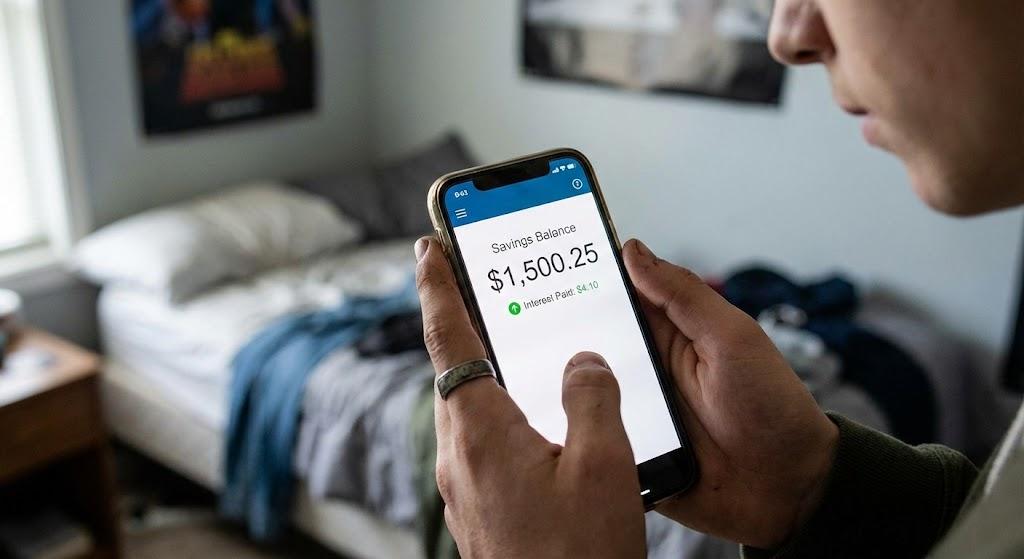
A savings account for kids is inherently secure. However, growth can be slow with only small deposits at minimal interest. Here are strategies to boost financial growth while keeping the account safe.
Start Early and Contribute Regularly
Time is the greatest ally in growing savings. The earlier you start, the more years of compounding you get. Even modest monthly deposits accumulate impressively over 15 or 18 years.
Depositing $50 per month from birth totals $10,800 in contributions by age 18. With moderate interest, the ending balance would be several thousand dollars higher. The key is consistency. Set up an automatic transfer each month into the child’s account. This “pay yourself first” approach, which works for adults, is equally effective for building a child’s fund.
Take Advantage of High-Yield Opportunities
Watch for special rates or accounts that accelerate growth. Some credit unions offer 5-10% APY on limited balances for kids. Use these to maximize interest on the first $500 or $1,000 of your child’s savings.
Beyond promotions, consider online banks with higher base rates than traditional banks. The difference between 0.1% versus 3% interest on a $5,000 balance is significant over years. Be mindful of balance caps or conditions to get the high rate.
Reinvest Gifts and Windfalls
Encourage your child to save at least part of any cash gifts. Birthday money from grandparents, holiday gifts, or job earnings can partly go into the account.
Try the “save half, spend half” rule. If a child gets $50, they spend $25 now. They deposit $25 for the future. This balances enjoying money with saving for later. Those occasional larger deposits will boost the balance nicely.
Consider Stepping Up to Investments When Appropriate
If the balance grows substantially (typically several thousand dollars) with many years before the funds are needed, consider allocating a portion to higher-growth investments while maintaining adequate liquidity. Some banks allow linking a portion of a youth account to a CD for a slightly higher fixed rate.
For longer term, transferring some funds to a custodial brokerage for an index fund is an option. Consider risk tolerance. Avoid investing a child’s entire college fund in stocks when they’re 16, as recovery time from a potential market downturn would be insufficient before the funds are needed.
But when they’re 6 years old, investing some of the fund for a decade could yield more growth than savings accounts.
Utilize Matching or Challenges
Make saving a game by creating challenges such as rewarding the child with an extra $20 if they save $100 by year’s end. Or match contributions. For every $1 the child deposits from allowance, add $1. This effectively provides a 100% immediate return on the child’s contribution through parental matching.
Even small matches can motivate kids to save rather than spend, functioning similarly to employer retirement account matches that incentivize adult saving behavior. A powerful incentive to not miss out on free growth.
Avoid Unnecessary Fees
Ensure the account stays fee-free. No money should drain out. Choose accounts with no monthly maintenance fee. Most kids accounts don’t charge one. A few do unless certain conditions are met.
Avoid ATM fees if the account has an ATM card. Teach your teen to use in-network ATMs. Every $3 ATM fee is $3 less available to earn interest and grow over time.
Ensuring Security and Low Risk for Your Child’s Savings
One main reason to use a kids savings account is the desire for security. Parents understandably prioritize keeping their child’s money safe. Here are important points on account security plus risk management.
Deposit Insurance
Verify that the bank or credit union is insured by the appropriate government scheme. In the United States, look for FDIC insurance (for banks) or NCUA insurance (for credit unions). These cover deposits up to $250,000 per depositor.
In the UK, ensure the provider is FSCS-protected. This covers up to £85,000, with higher amounts for temporary high balances. Most developed countries have similar deposit insurance frameworks.
This insurance means even in unlikely bank failure, your child’s money is government-guaranteed. That’s critical for peace of mind.
Joint Control and Account Restrictions
As the adult on the account, you have control to prevent unauthorized use. Young children typically cannot make withdrawals without parental consent. Even teen accounts allow parental locks or alerts.
Use these features so savings aren’t accidentally drained by the child. Keep the bulk of funds in savings. Transfer only small amounts to a teen’s spending account as needed. The nest egg remains intact, safe from daily spending temptations.
Low Risk, Lower Reward
Remember that secure saving is by nature low-risk, low-reward. Money in a kids’ savings account will grow gradually through modest interest rather than generating high returns quickly. With typical interest, it might take many years to grow substantially. This is the trade-off for being virtually risk-free.
Avoid chasing very high returns with the child’s entire savings if it means high risk exposure. Allocating a significant portion of their savings to volatile investments like cryptocurrency or speculative stocks carries substantial risk of loss and is generally inappropriate for children’s savings goals. It’s often said: “don’t invest money you can’t afford to lose.” For many parents, money set aside for a child needs caution.
The security of an insured account or conservative investment allocation is worth it. Even if returns are modest.
Fraud Protection
Teach your child, especially as a teenager with online access, about basic security. Don’t share account passwords or PINs. Beware of phishing emails or texts about their bank.
The bank’s security protects against external fraud. You’re monitoring the account. But it’s a good opportunity to instill safe online banking habits early.
Tax Considerations
In most cases, a child’s savings won’t generate enough interest to owe taxes. Still, be aware of local tax rules.
In the UK, a child can earn up to the personal allowance (£12,570 in 2025/26) in interest income before paying tax, though earning interest of this magnitude would require substantial savings (over £250,000 at typical interest rates). The catch: in the UK, if a parent’s gift to a child produces over £100 of interest annually, that interest is taxed as the parent’s income. Note that gifts from grandparents and other relatives are not subject to this rule.
In the U.S., “kiddie tax” rules mean a child’s unearned income above $2,600 (2024 threshold) is taxed at the parent’s marginal rate, though the first $1,300 is tax-free and the next $1,300 is taxed at the child’s rate. These scenarios are relatively rare unless the child has a very large account. Consult a tax advisor if your child’s account earns interest beyond tax-free limits.
Beyond Traditional Accounts: Maximizing Returns Securely
While a basic kids savings account is ultra-safe, some parents seek higher returns. They want to avoid exposing their child’s money to excessive risk. Traditional gold investments are often considered a safe-haven asset during economic uncertainty. Unlike interest-bearing accounts, physical gold ownership does not generate ongoing income, though it may appreciate in value.
Innovative financial products are emerging to bridge the gap between security with growth. One such solution is the GoldFlex account. This specialized account leverages gold trading for returns.
How GoldFlex Works

GoldFlex is not a standard gold savings account where you simply hold gold in a vault. Instead, GoldFlex takes your deposited funds. It directly invests them in raw gold that is actively traded in the market.
Your money is used to buy physical gold. That gold is then bought and sold multiple times. The goal: capturing gains from price fluctuations. Profits from these frequent gold trades are returned to the account holder as yields.
Your money starts working immediately. It doesn’t sit idle as a bar of metal earning no interest. The approach combines gold’s stability with a more predictable, steady return. This approach aims to generate returns similar to interest through continuous trading operations.
The capital is continually cycled through gold purchases and sales. This generates profit credited back to the investor. The underlying value remains secured by tangible gold.
GoldFlex as an Alternative
GoldFlex positions itself as a flexible, higher-yield alternative to fixed deposits or ordinary savings. It’s designed for safety and return. Your money is asset-backed yet still earning more than a passive account would.
This can appeal for long-term child savings. Parents get reassurance of a gold-backed reserve. The child’s fund can potentially grow faster than in a minimal-interest bank account.
Conclusion: Building Financial Growth from Childhood
Starting a kids savings account for your child is one of the greatest gifts you can give. It’s not just about the dollars, euros, or pounds that will accumulate. It’s about instilling a mindset of saving, patience, and financial savvy.
Combine the best of both worlds by staying informed about innovative options like GoldFlex. Consider if they fit your child’s investment plan. Remember the core principles. Keep the money safe. Keep costs low. Involve your child in the process. Think long-term. With early planning and the right account choices, you set your child on the path to a stable financial future.