
Understanding the Payback Period and Its Importance

A shorter payback period means the project or asset returns the invested capital quickly. This reduces the window of risk. The sooner capital is recovered, the less chance that something can go wrong before breakeven.
Context Matters
Payback Period Versus Breakeven Point

Handling Uneven Cash Flows
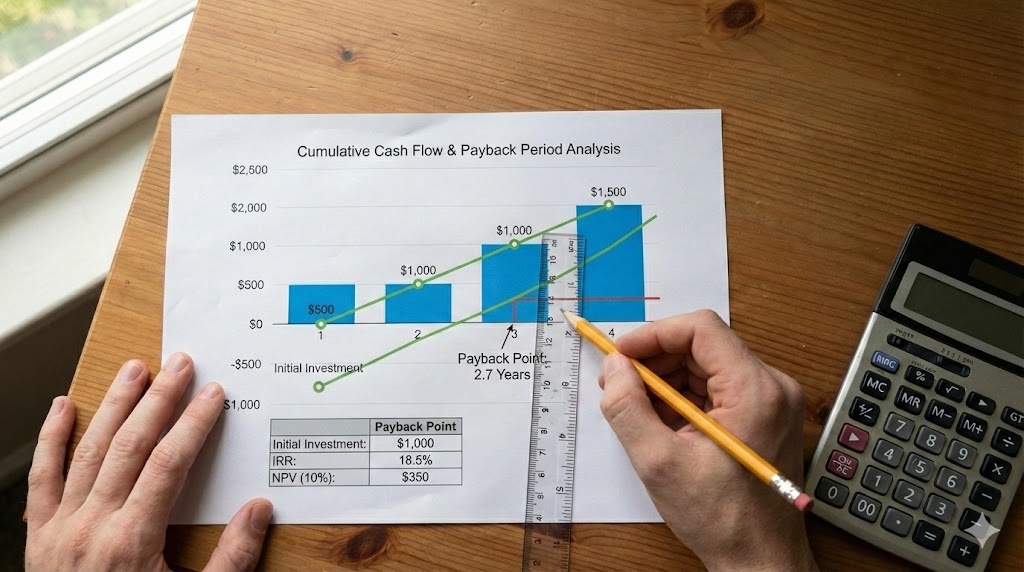
If the cash flow is not uniform each year, a slightly different approach is used. You would track cumulative cash flow year by year until the total equals the initial investment. Suppose a startup invests $175,000 in a project that brings in $50,000 in year 1, $75,000 in year 2, and $100,000 in year 3. By the end of year 3, cash inflows sum to $225,000, which exceeds the initial cost.
The payback occurs during year 3, and by interpolation, one can estimate the exact payback time by seeing how far into year 3 the breakeven point is reached—in this case, about 2.1 years. This cumulative method is essentially a manual way of finding when breakeven happens if cash flows vary.
Simple Versus Discounted Payback Period
The calculation above describes the simple payback period, also called nominal payback. It treats all cash flows at face value, and while simplicity is its strength, this method has a major limitation: it ignores the time value of money. A dollar of return received five years from now is valued the same as a dollar received today, which is not realistic because money today can be invested to earn interest.
The Discounted Payback Period
Analysts sometimes calculate the discounted payback period to address this limitation. Each future cash flow is first discounted to present value using a chosen discount rate (often a required rate of return or cost of capital), and then the cumulative total of discounted cash flows is used to determine when the initial investment is paid back in present value terms.
Discounting will naturally lengthen the payback time because future cash flows are worth less in today’s dollars; in the earlier example, applying a 10% annual discount rate results in a longer payback period of about 2.85 years. The discounted payback period is generally longer than the simple payback for the same project, accounting for the fact that one dollar earned in year 5 is worth less than one dollar earned in year 1.
Comparing Simple and Discounted Methods
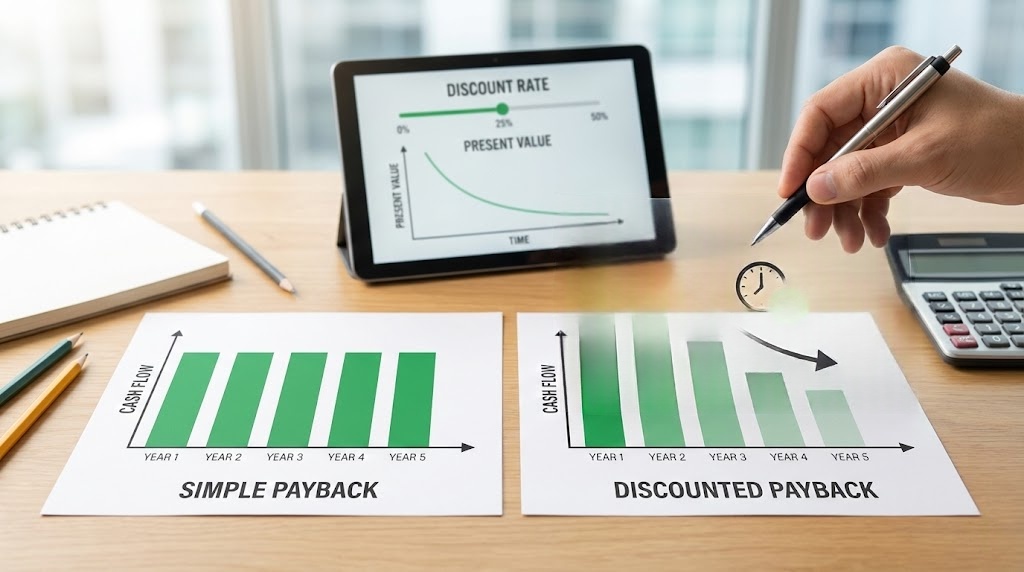
The simple payback period does not consider time value of money, future cash flows are not discounted, and the calculation simply divides initial cost by average annual cash flow.
The discounted payback period considers time value of money by discounting cash flows to present value before calculating, with cumulative discounted cash flow computed each period until it equals initial cost, making it more precise and appropriate when time value needs to be factored into the decision.
Both methods yield a time-to-breakeven metric, though the discounted payback provides a more realistic view in projects where time value of money is significant.
What Is a Good Payback Period
Industry Variations
A good payback period is the shortest one that aligns with the investment’s lifespan and the investor’s requirements, with the key being that the investment returns capital quickly enough to meet the investor’s risk tolerance and liquidity needs.
Advantages and Disadvantages of the Payback Period

Advantages
It provides a clear focus on liquidity and risk, as projects with fast paybacks free up capital sooner and are less exposed to adverse developments over time.
Disadvantages
The payback period method has significant limitations despite its usefulness, as it ignores the time value of money by treating one dollar received years later the same as one dollar today, which means it can misrepresent the true economic value of long-term projects. Payback also ignores any cash flows after the payback cutoff, telling you when you get your money back but not what happens after that.
It fails to measure total profitability, as a project that breaks even in 2 years and then dies is considered better by payback than one that breaks even in 4 years but then generates huge profits in years 5 through 10.
Using Payback with Other Metrics
Financial analysts often use the payback period as a supplementary metric rather than the sole basis for a decision, as it works best alongside metrics like Net Present Value and Internal Rate of Return, which account for time value and total returns. Payback tells you about capital recovery speed, NPV tells you about value added, IRR tells you the rate of return, and each has its place in a comprehensive capital budgeting analysis.
Using Payback Period in Investment Decisions
The payback period is especially favored in certain scenarios because of its focus on timing.
Capital Budgeting Under Constraints
If a firm has limited funds and needs to choose among projects, it might prioritize those that pay back fastest to recycle capital quickly, with companies on tight budgets using payback period as a hurdle by selecting investments that return cash in three years or less to ensure liquidity. This is common when liquidity is a major concern, such as for small businesses or during economic uncertainty, and a short payback can sometimes even outweigh a higher NPV project if the company absolutely needs cash recovery sooner rather than later.
Fast Changing Industries
In industries where technology or market conditions change rapidly, a long payback period increases risk. The project’s premise might become obsolete before it pays off, so companies in high-tech or startup sectors often set very stringent payback targets, preferring to get their investment back quickly so that if the landscape shifts, they have not left money on the table.
After the Payback Period
Once the payback period is achieved, the investment is essentially de-risked in the sense that you have gotten your initial money back. After that point, any further returns are pure gain, though a short payback does not guarantee overall success—it just buys peace of mind sooner and should not replace deeper analysis.
Think of payback period as a screening tool or an initial checkpoint that can quickly filter options or highlight potential concerns, though before making final decisions, investors should examine profitability through NPV, efficiency through ROI, and strategic fit.
GoldFlex: A Case Study in Predictable Payback and Returns

Payback period considerations apply to gold investments in interesting ways. Traditionally, investing in physical gold like gold bars or a gold savings account is seen as a safe store of value, though it has a drawback: gold itself does not produce regular income like interest or dividends.
The Traditional Gold Challenge
The payback on a bar of gold sitting in a vault is entirely dependent on the gold price rising over time, so if gold prices stagnate, an investor holding physical gold might wait many years to break even relative to another investment, as there are no cash inflows aside from selling the gold. In a traditional gold account, the return comes solely from potential price appreciation, which can be slow and unpredictable with effectively no periodic yield, making the concept of a payback period moot unless the gold is sold at a profit.
How GoldFlex Works
Modern solutions like GoldFlex aim to make gold investments yield regular returns. A GoldFlex account is not a typical gold holding account with idle bullion. Instead, it is a flexible gold investment system where your capital is actively used to buy and sell gold multiple times in the market. This generates profits from price differences.
GoldFlex turns gold into an income generating asset by trading on gold price movements. Your capital is immediately deployed through these ongoing gold transactions. An investor with a GoldFlex account may earn periodic returns through active trading rather than just waiting for the gold’s value to appreciate, though trading returns are variable and subject to market conditions.
Shorter and More Predictable Payback
GoldFlex is designed to provide more guaranteed and steady returns. Investors may potentially achieve breakeven through trading activities, though the timing depends on market performance and trading execution.
Combining Security with Income
By actively managing the gold, GoldFlex addresses the downside of traditional gold investing where gold earns no interest. It marries the security of gold with the income generation of an investment account. This strategy not only potentially shortens the payback period but also makes the returns more predictable.
An investor can plan with greater confidence. Their gold investment is not solely reliant on uncertain long term price gains. It produces ongoing cash flow. GoldFlex offers a way to get your investment paid back in a more reliable timeframe. After that, you continue to earn net gains.
Conclusion
The payback period is a simple yet powerful metric for anyone looking at an investment, as it answers a fundamental question: when will I get my money back? A shorter payback period implies quicker recovery of capital, which generally means an investment is less risky and more liquid.
This metric has to be balanced with other considerations, as it does not account for the time value of money, ignores what happens after breakeven, and can potentially bias against long-term benefits. While a payback period analysis is an excellent starting point for quick comparisons or initial screenings, savvy investors and financial managers will dig deeper by examining NPV, IRR, and ROI for profitability and efficiency while also considering qualitative factors.
Use the payback period to gauge risk and liquidity needs, as if you require investments that return cash quickly, the payback period will spotlight those. If you are evaluating something like GoldFlex or other innovative accounts, look at how such products shorten and firm up the payback timeline by generating steady returns.